

When the Rain Came Down, Collaboration Rose to the Challenge at UTPB
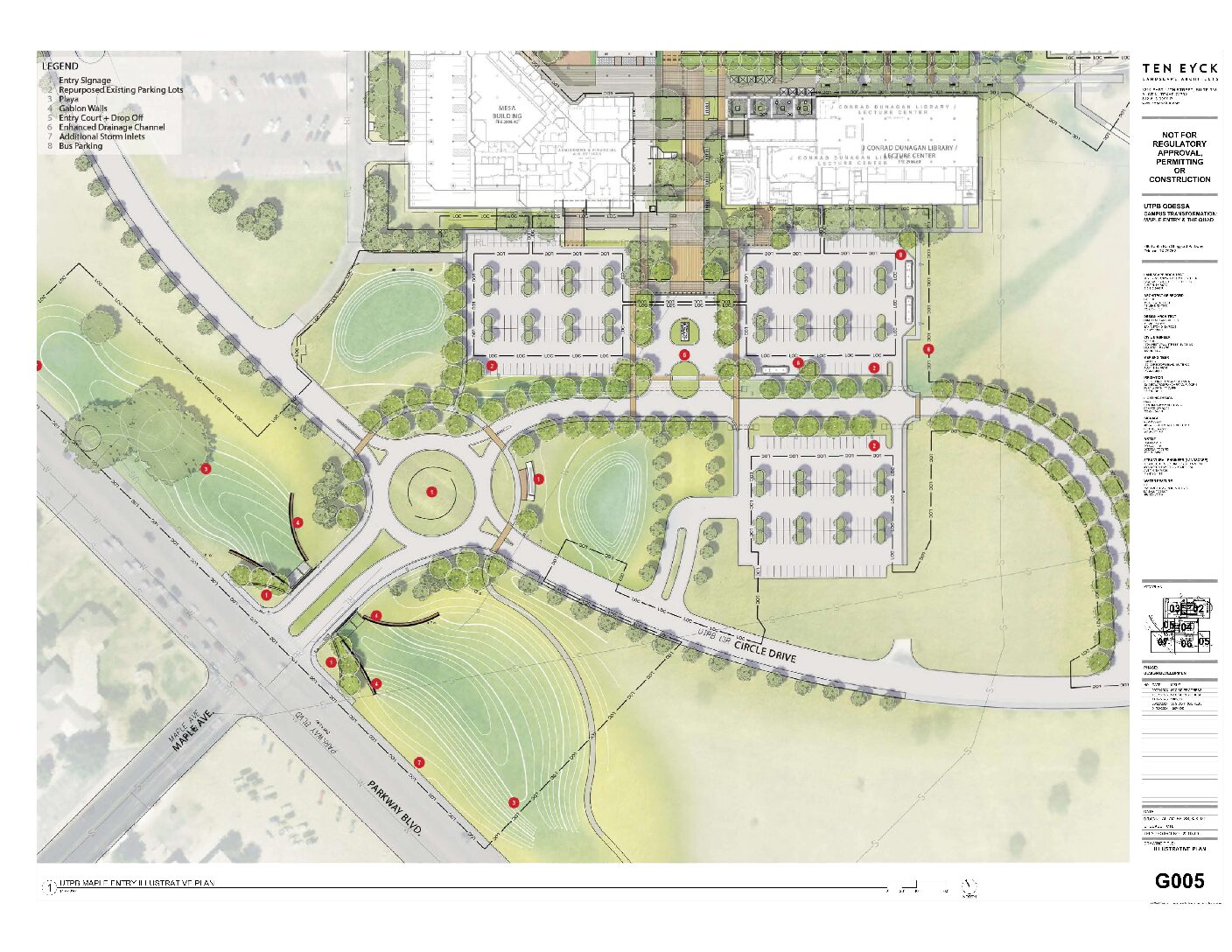
The University of Texas Permian Basin (UTPB) in Odessa, Texas, is known for its programs supporting the rapidly growing energy sector, including petroleum, mechanical engineering, energy marketing, and finance. Following significant rain events, students entering campus at the main entrance at John Ben Shepperd Parkway and Maple Avenue had difficulty navigating flooded parking lots and pedestrian areas.
Through engineering, planning, and landscape architecture, Parkhill, in collaboration with UTPB and Ten Eyck Landscape Architects, worked to solve the flooding problem while also improving the campus environment, renovating the entrance, and adding a roundabout featuring a new piece of public art titled “Time to Fly.”
Parkhill civil engineers Amber Sanchez, PE, on the Stormwater Team, and Amanda Benson, PE, on the Transportation Team, worked together on the interconnected efforts for the entrance and “The Quad,” a gathering spot on campus with new dedicated parking areas designed by Site Development and Planning Team members Kellie Painter, PE, and Logan Derise, civil engineer-in-training.
Amber said her goal for the project was to reduce flooding without simply shifting the large amounts of water into another location. Above-average rainfall in recent months has put the near-complete design to the test.
Following the Flow
Amber said the advanced 2D modeling software helped the team understand how water flowed onto campus and was distributed through campus. The team modeled different scenarios to figure out what design would work best. Recent storms affirmed that the chosen design did what it was intended to do.
“Our Stormwater Team is able to think outside the box with 2D modeling. We can look at the big picture from a bird’s-eye view and prevent unforeseen challenges that are often unrecognizable with traditional drainage calculation methods.”
Transportation Perspective
From a transportation perspective, Amanda said her goal was to improve campus accessibility, enhance traffic flow, and support long-term growth while being mindful of all the elements being integrated to create an attractive new campus entrance and address the critical drainage needs.
“This level of coordination was essential to delivering a cohesive final product, and it highlights the value of strong communication across disciplines,” Amanda said. “The continued development of the “Quad” will further enhance the campus, and I’m excited to see its unveiling in the near future.”
Balancing Beauty and Function
The design included an additional large-scale box culvert underneath the entrance for stormwater to drain into a channel. Native plants along three ditches, connected by widened arterial channels, utilize the rainwater while keeping the landscape low-maintenance and naturally beautiful. Two detention ponds were also designed to reduce flooding in the parking lots. The entry was regraded to direct water to those ponds, and the culvert system carries the water out to the southern end of the channel. The new roundabout and dedicated bus parking areas add to the improved function of this welcoming area.
“My typical projects do not often involve extensive beautification components, so seeing the sculptures and landscaping come together as part of this effort added a unique dimension,” she said. “It reinforced a strong sense of pride and accomplishment in contributing to a project that evolves from design plans into a tangible, impactful space.”
What seemed like a nearly impossible project accomplished what was necessary and more. The design reconciled the practical demands of a large-scale drainage system but also fulfilled a vision for a campus entrance that felt welcoming and alive.
“The flooding was so extensive, and while we wanted to improve conditions for the campus, we could not worsen conditions in the city’s roadway and easements,” Amber said. “It seemed the only way to make it work was to design a massive channel to hold the water, but Ten Eyck (the landscape designer) was intent on making it beautiful. It was difficult to strike a balance between functional and beautiful, but we did it together.”
The project is planned to be completed by August 2026 in time for the students, faculty, staff, and visitors returning for the fall semester.
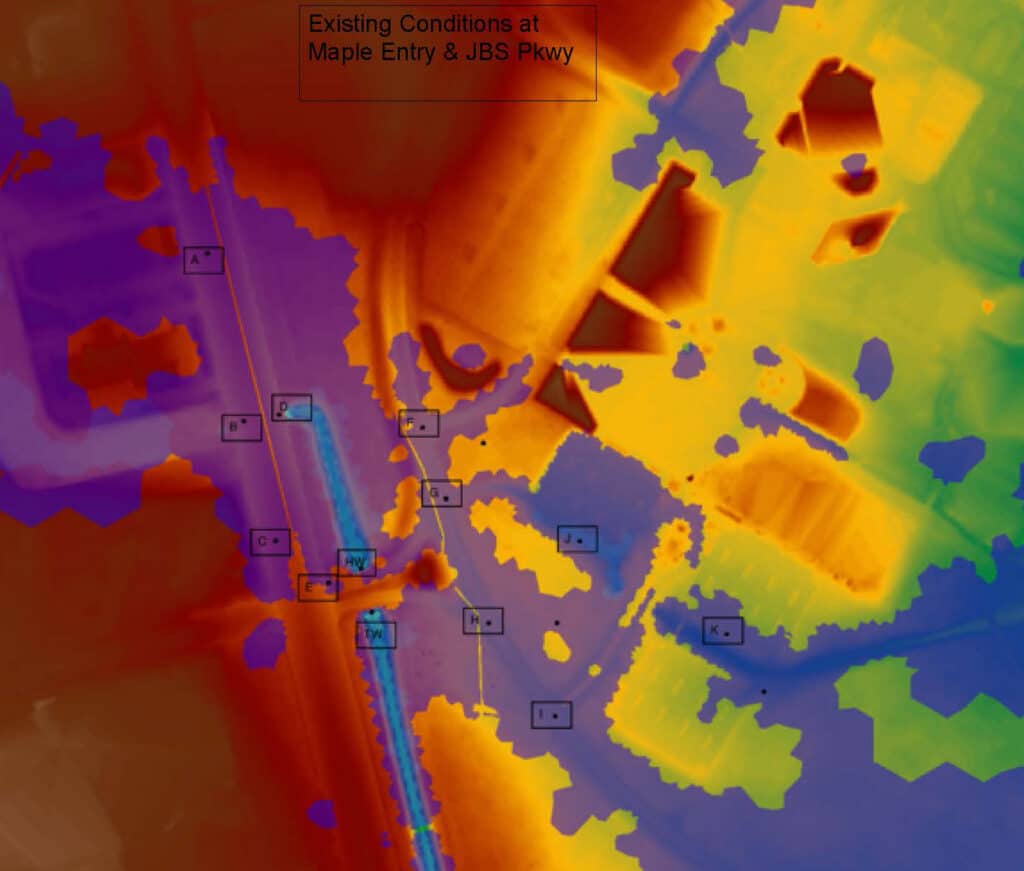 This 2D model maps the terrain of the UTPB campus (the reds, greens, and oranges) with the flooding overlaid (the blues and purples).
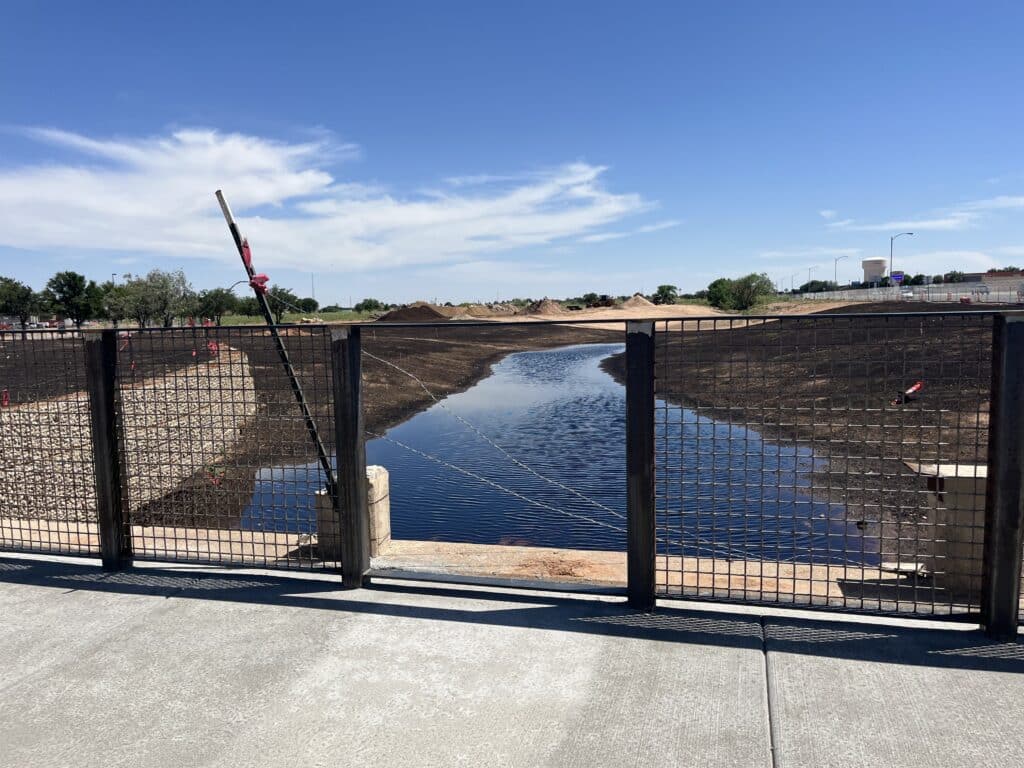 Using 2D modeling, the team was able to look at the overall area to come up with a solution and prevent unforeseen challenges that are often unrecognizable with traditional drainage calculation methods.
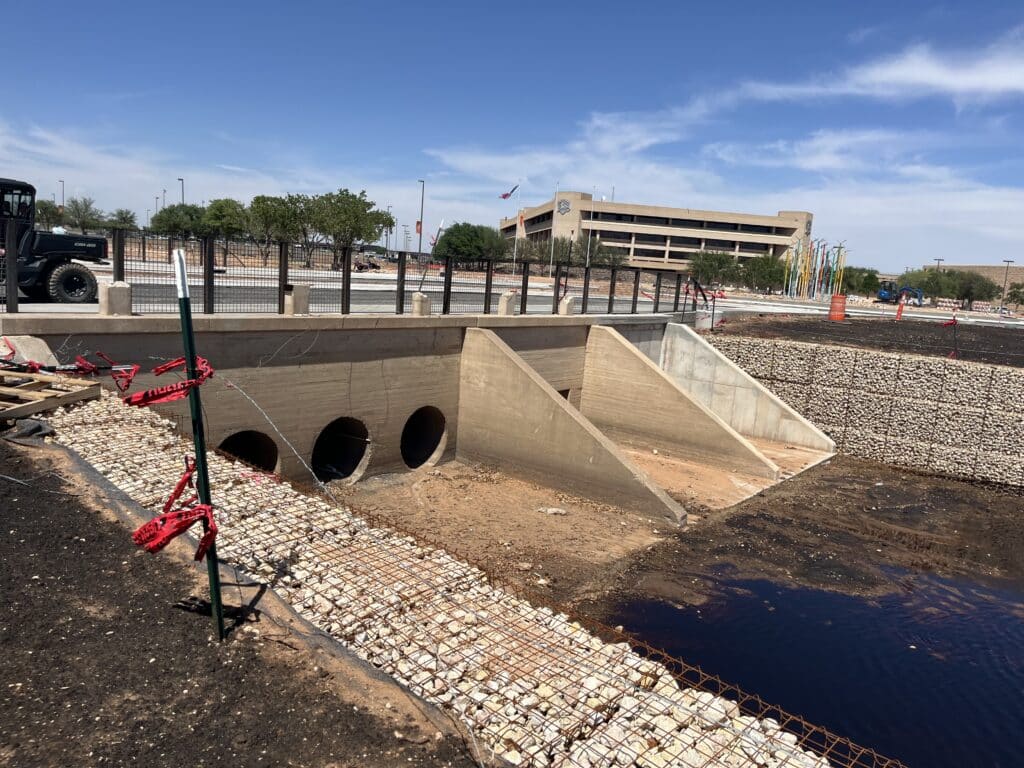 The design included an additional culvert underneath the entrance for stormwater to drain down a channel. The entry was also regraded to direct water to the ponds and a culvert system to carry water out to the southern end of the channel.
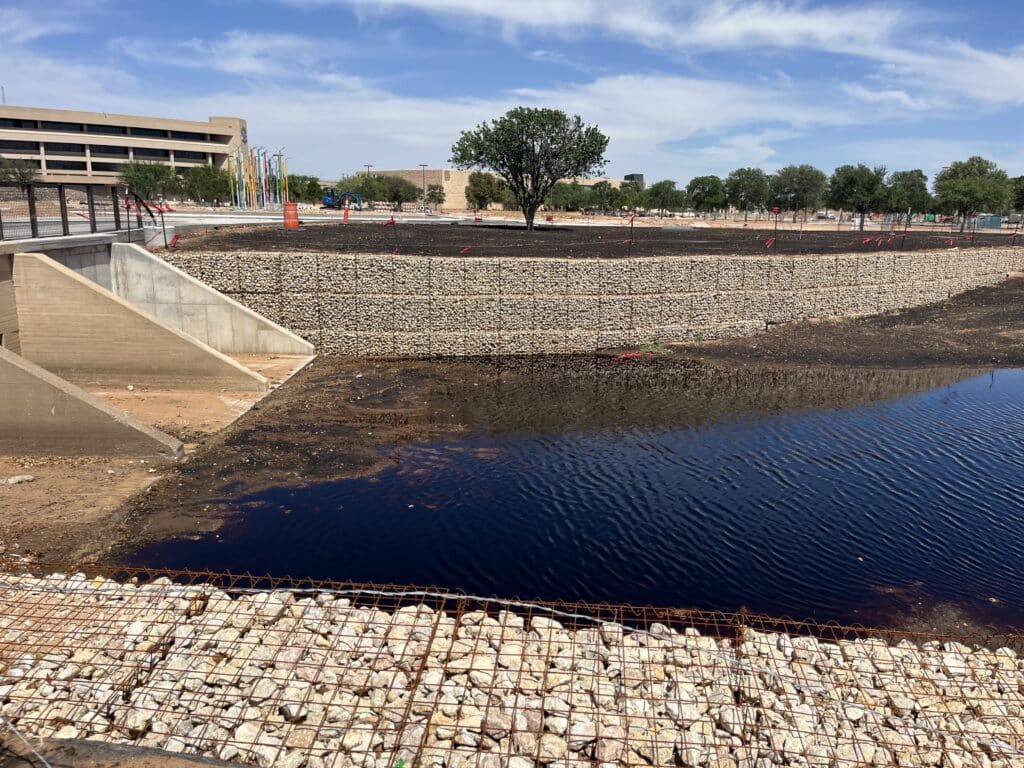 Native plants along three ditches in the design will utilize rainwater, keeping the landscape low-maintenance and naturally beautiful.